
How to Check for a Warrant in New Mexico
Start with whatever paper you already hold: a citation, a summons, a court notice, or a case number. New Mexico runs four court tiers, District, Magistrate, Metropolitan, and Municipal, and each court has its own clerk. The name of the county alone may not tell you which court has the case. For a free public case summary, the official New Mexico Case Lookup is the place to look. Just know its limits. It is not an active-warrant register, and it cannot certify that your record is clear.
- Search Case Lookup by the name or case number shown on the notice. Treat a result as a lead to the court file, not proof of current warrant status.
- Use the court and citation details to identify the issuing clerk. The New Mexico Courts directory can distinguish District, Magistrate, Metro, and Municipal locations.
- Ask the issuing court whether the warrant remains active, what event caused it, whether an appearance is required, and what process applies to a motion, surrender, or release condition.
- Check the relevant county sheriff or city law-enforcement channel for service information. Some counties publish a search; others direct people to a phone line, records desk, or in-person process.
- For an existing public agency record, make a request under IPRA to the agency that holds it. A records request is not an immediate status check and cannot require a new statewide list or restricted system query.
A municipal case can still require a phone call to the city court, even when the county sheriff posts a public portal. If Case Lookup comes back empty, ask the court named on the citation directly rather than treating the blank result as clearance. A relative helping out should have the case number in hand and contact the record-holding court before traveling anywhere or paying a fee.
New Mexico Warrant Case Lookup Limits
New Mexico Case Lookup is the statewide public case index, not a full warrant search. It can locate docket information in the court tiers it covers, but its own notice states that online information is not the official Judiciary record. The simple search does not hand over court documents. Juvenile criminal matters have not appeared there since July 1, 2007. Municipal visibility runs only to selected historical domestic-violence and DWI conviction data, not all city traffic or ordinance cases. The Judiciary's public-access description adds that records can be sealed, restricted, older than the converted electronic file, or otherwise unavailable online. So a missing entry may simply mean the case sits outside the portal's scope, not that the court has no order. The official public-access page spells out these limits. When a case does appear, take its court and docket details and ask the clerk for the current status. The Case Lookup search interface shows the public case-search controls without opening any person's result. Open the official New Mexico Case Lookup to see its current search entry point.
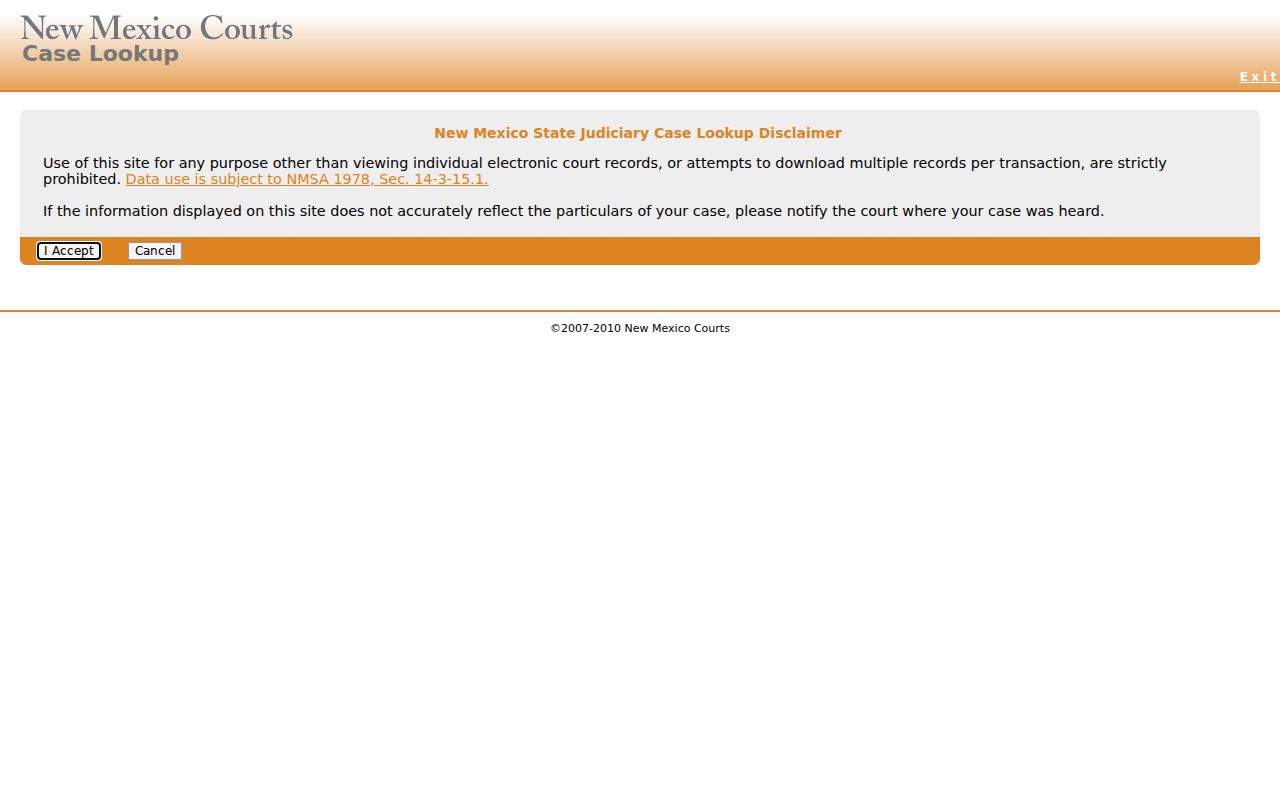
This New Mexico case-search service is a lookup tool, not a live warrant result or a complete warrant-status screen.
The New Mexico Statewide Warrant System
No public database lets you search every active warrant across all New Mexico counties and courts. The statewide public service is Case Lookup, which indexes court cases rather than warrants alone. Inside the Judiciary, staff use Odyssey to create and track some court warrants. Restricted criminal-justice systems carry warrant information for authorized officers. These pieces are related, but none of them adds up to one public warrant portal. The issuing court keeps the case order, the warrant return, and the judicial status. A sheriff may hold its own service record, and city police can serve municipal process. Once you know the court, the county directory connects you to that local layer. For the court-to-state exchange, the authorized systems, and the history of electronic processing, see the New Mexico warrant system overview.
How New Mexico Odyssey Sends Warrants
The Judiciary's failure-to-appear procedure describes an Odyssey workflow used by court staff in District, Magistrate, and Bernalillo County Metropolitan Courts. A judge orders the correct Failure to Appear in Court (FTA) Warrant in an existing case. Staff then record it, check whether the message validates, and send it through an electronic route to DPS at participating locations. The same path can carry cancellation or disposition updates. Where a location lacks the automated route, staff follow manual procedures instead. The first electronic phase was announced on January 29, 2024. At launch, the Judiciary counted participating court locations in 26 of 33 counties and nearly three-quarters of Magistrate Courts. That is a historical launch figure, not a current coverage map. No public list shows which locations now transmit warrant messages, and a successful agency transmission does not create a public search service. The Judiciary's FTA warrant procedure describes the staff workflow, and the 2024 launch announcement explains the first phase. Neither is a public query tool.
Types of Warrants in New Mexico
The warrant type depends on the case and on what brought it before a judge. New Mexico's standard term for a missed appearance is a bench warrant. The Judiciary workflow often labels it a Failure to Appear in Court Warrant. A failure-to-pay warrant is a separate post-judgment process. Some jurisdictions use capias for an order bringing someone before the court, and capias pro fine for a fine-collection warrant; neither is a New Mexico statewide label. Read the wording on the court order itself, and ask the issuing clerk what it means.
| Warrant Type | How It Arises | Who Issues It |
|---|---|---|
| Arrest warrant | Judge finds the required basis in a criminal case | District, Magistrate, Metro, or Municipal Court within its authority |
| Bench warrant | Missed hearing, subpoena, release condition, contempt, or another court order | Judge in the existing case |
| Failure-to-pay warrant | Post-judgment nonpayment or failure to perform after required court steps | Issuing Magistrate, Metro, or Municipal Court |
| Search warrant | Probable cause to search a described place or person for evidence | Judge under the applicable rule |
| Federal or fugitive warrant | Federal process or a demand from another jurisdiction | Federal court or the demanding jurisdiction |
New Mexico courts issue several kinds of orders. A search warrant authorizes a search; it is not a list of arrest warrants. A bench warrant grows out of a case already open, while an arrest warrant can start a new criminal matter. Before guessing what yours does, ask the issuing court which order was signed.
New Mexico Warrant Courts by the Numbers
New Mexico's court system spreads across county lines. The Judiciary lists 34 District Courts in 13 judicial districts. Another 46 Magistrate Courts sit alongside them. Bernalillo County runs one countywide Metropolitan Court. Municipal Courts handle city matters. A single District Court location or district may serve several counties, so a case can sit farther from home than expected, while a city citation usually stays with its Municipal Court and Bernalillo County criminal matters go to the Metro Court. Detailed Judiciary profiles now count 46 Magistrate and 81 Municipal Courts. Some footer text still shows the older figures, 43 and 78. The counts above follow the detailed profiles. To identify one court and its clerk, use the courts-by-county list and the August 2026 Master List. These are court counts, not warrant counts. New Mexico publishes no statewide total of active warrants.
What a New Mexico Warrant Record Shows
New Mexico's blank arrest and bench warrant forms show what courts and officers record. A public case index may show less detail. The signed order itself can carry the fuller picture. Protected identifiers stay out of public material. And the warrant number is no statewide public search key with a confirmed universal pattern.
| Warrant Number | Court-specific Ask the issuing clerk for the number and document when available. |
|---|---|
| Case Number | Identifies the court file. A docket number is not the same as a warrant-status result. |
| Charge or Reason | May identify a criminal charge, missed appearance, release condition, contempt, or another court basis. |
| Issuing Court | Names the judge's court and the clerk who maintains the court record. |
| Bond or Release | Shows terms set by the order. There is no single statewide amount for every warrant. |
| Status and Return | May record service, surrender, cancellation, return without service, and removal or update in an information system. |
Form 9-210 covers court, case, charge, execution-scope, information-system, signature, and officer-return fields. Form 9-212C handles Magistrate and Municipal cases. It adds reasons, bond or release options, and status fields. The forms are blank schemas. They do not prove an online search displays each field.
New Mexico Warrant Status Words
New Mexico's Odyssey case system tracks court-status labels after a warrant issues. Not every label appears in the public case index. A docket event may not show live law-enforcement status. Ask the issuing court what the entry means now, and whether a cancellation reached the agency holding the warrant.
- Issued
- The judge-authorized warrant was created and entered for the case.
- Served
- The warrant was executed or handled through the service process described by the court procedure.
- Canceled
- The court withdrew the warrant; this does not by itself dismiss the underlying case.
- Surrender
- The person resolved the appearance order through a court-approved return or contact; other case obligations can remain.
- Returned unserved
- An officer returned the instrument without carrying it out; the court still controls later status.
Other documented labels include “Issued in Error” and “Served on Booking Notice.” Read none of them outside their case context. A served warrant can mean the arrest already happened. A canceled one may still leave a new hearing, fine, probation term, or other order in place.
Public Access to New Mexico Warrant Records
New Mexico's Inspection of Public Records Act (IPRA), NMSA 1978 §§14-2-1 through 14-2-12, governs inspection of existing public records held by state and local bodies, subject to exceptions. Court records also follow Judiciary access rules. A record may be sealed or restricted by rule, statute, or order. Juvenile criminal records sit outside the public Case Lookup. Public access does not open NCIC. No court has to create a new all-warrant database.
Key access rules:
IPRA guidance explains request handling and the written response required when inspection is not permitted within three business days.
Rule 1-079 NMRA governs public access, confidential records, and sealing in New Mexico courts.
Senate Bill 47 changed the license consequence tied solely to failure to appear or pay; it did not erase a court warrant or traffic case.
Match each request to the holder. Ask the court for a filing, the sheriff for a service record, and DPS for an existing DPS record. If denied, ask which exception applies and whether a redacted portion can be released. An online search is not a status certificate.
Safe Surrender Is Event-Specific
New Mexico Courts runs a Safe Surrender program, with scheduled chances to address certain bench warrants before judicial staff. The statewide effort began with a 2010 event. Later events followed on their own schedule. Court Operations reports that 92 percent of voluntary participants resolved their cases without further noncompliance. Those figures describe participants and events, not a statewide count of open warrants. The Gallup event on March 27 and 28, 2026 accepted outstanding bench warrants from any New Mexico Magistrate Court. It offered a new date, a payment plan, or another compliance path. It promised no immunity, dismissal, or fee waiver. Those dates have passed. Check the Court Operations events page for the next one. Confirm details with Court Operations. Or call the issuing court before relying on any future event.
New Mexico Traffic Warrants and MVD
A ticket, a bench warrant, and a driver-privilege record are separate matters in New Mexico. Miss a required court date. A judge can then issue a bench warrant. MVD handles driver privileges and some penalty assessments, but it says it does not issue or provide warrant information. The court named on the ticket controls warrant status and sets instructions for appearance, payment, or relief. Senate Bill 47 ended license suspension solely for failure to appear or nonpayment. Restoration was free for eligible privileges. MVD reported more than 100,000 New Mexico licenses restored and over 160,000 out-of-state privileges cleared under the change in July 2023. That did not dismiss tickets, waive fines, or cancel court orders. Older MVD text lags behind. It still describes the prior FTA suspension rule. Read it alongside the current MVD statement and the ticket instructions. For an existing traffic warrant, contact the issuing Municipal, Magistrate, or Metro Court. If a payment portal accepts a fine, ask the court whether an appearance or other condition remains. A payment alone does not recall a warrant.
Missed a New Mexico Court Date?
Pull the notice or case file out first. Then call the official clerk. That one call should settle several things before you choose a next step. Ask whether the order is an FTA bench warrant or a different warrant type. Ask whether it remains active. Ask whether a judge requires an appearance. Ask whether a motion to recall or quash can be filed. Recall asks the judge to withdraw the warrant. Quash asks the judge to set it aside. A clerk can explain the filing steps but cannot give legal advice, and counsel can help you assess a New Mexico case before a surrender or a court statement. If the issue is inability to pay after judgment, the current Magistrate, Metro, and Municipal rules provide ability-to-pay review and possible installments or community service. Rules 6-207.1, 7-207.1, and 8-206.1 took effect October 9, 2025. In the usual first missed-payment sequence, a summons and an opportunity to respond or request a hearing come before a warrant. The rule depends on the court and the case. It is different from an initial missed criminal hearing in a New Mexico court. Ask the court about your balance and the process that applies. A New Mexico court can update its own warrant, but the case may still need a new hearing or separate compliance. Keep any order, receipt, or new appearance date, and confirm the court sent needed status updates to law enforcement.
New Mexico Warrant Requests Under IPRA
An IPRA request asks a public body for a record it already holds. It cannot do everything. It does not require DPS to query NCIC. It cannot compel a sheriff to create a new statewide warrant list. And it never replaces a court clerk's current status confirmation. Describe the record narrowly. An existing service return or policy document is one example. Request court orders and filed papers from the court, not from a separate law-enforcement agency. The New Mexico Department of Justice says a public body must permit inspection promptly. If inspection is not allowed within three business days, the custodian must send a written response explaining when access or a further response will occur. The guide describes extensions and possible copy charges. Confirm the current fee with the actual custodian. The DPS GovQA request portal is for public records. It is not for live warrant checking. For a case involving a person or family member, identify the court first and ask its clerk how to confirm current status. A public records request takes time. It cannot uncover sealed, juvenile, or restricted information. Use it for a specific record, not as a substitute for an urgent New Mexico warrant answer from the issuing court.
Find Warrants by County in New Mexico
The court that issued the order and the county or city agency that serves it give the best local answer. New Mexico has 33 county subdomain pages. Picking a county narrows the route. Still, one county can hold District, Magistrate, and Municipal cases. Bernalillo County also runs a separate countywide Metropolitan Court. Check the court printed on the citation or case before using a sheriff channel.
Bernalillo County
Albuquerque · largest county by 2020 population; Metro Court and BCSO have separate records.
Doña Ana County
Las Cruces · southern New Mexico's second-largest county; court and sheriff records follow local routing.
Santa Fe County
Santa Fe · city Municipal Court and county Sheriff's Warrants Division are separate channels.
Sandoval County
Bernalillo · Thirteenth Judicial District; confirm the court and case type first.
San Juan County
Aztec · Eleventh Judicial District; the issuing court controls warrant status.
Valencia County
Los Lunas · Thirteenth Judicial District; court choice depends on the citation or case.
Browse the full directory of all 33 New Mexico counties to reach the county page. Then confirm the court by case type and record number.