
Active Warrants in New Mexico
No public New Mexico service returns every active arrest, bench, traffic, probation, juvenile, child-support, or municipal warrant from every court. Each tool answers to a different record holder. The Judiciary's public Case Lookup is a case index with court and record limits. Law-enforcement wanted-person databases stay restricted to authorized users. A sheriff's search may cover only that agency's service file. A most-wanted page selects a handful of cases by choice. An active or outstanding warrant generally means the court issued an order and has not recorded its service or cancellation as complete. The court's order and docket control the case status. Online lists help find leads. They can lag behind a recent return, surrender, or court change. Confirm the issuing court, the case number, and the current status before you rely on any result, or on its absence.
New Mexico Warrant List Coverage
Three public routes in New Mexico get mistaken for one statewide warrant list, and the boundaries matter. A case index helps you find court files. A sheriff's tool stays local. Supervision or fugitive pages carry selected records only, so none of these is a public all-court query.
| Service | What It Covers | What It Does Not Confirm |
|---|---|---|
| New Mexico Case Lookup | Public case summaries in supported Judiciary court tiers. | Current status for every warrant; full case documents; juvenile or full municipal dockets. |
| County sheriff portal | A local agency's published warrant search, where one is offered. | All counties, every court, or complete statewide coverage. |
| New Mexico Corrections Department (NMCD) Offender Search | State custody and supervision information, including a separate absconder subset. | General court, sheriff, city, or Metro warrant confirmation. |
| U.S. Marshals Service (USMS) profiles | Selected federal fugitives and official profile contacts. | A complete federal or New Mexico warrant register. |
| FBI National Crime Information Center (NCIC) | Restricted criminal-justice wanted-person information. | A public civilian name search. |
New Mexico's Department of Public Safety (DPS) and its State Police handle law-enforcement work, but neither publishes a public portal listing all active warrants or a statewide most-wanted roster. Wanted-person data flows through restricted channels. A criminal-history service or public-record request does not create access to a restricted NCIC query.
Note: The table describes public services; restricted law-enforcement systems are not available for a civilian warrant query.
How Statewide Active-Warrant Data Works
Inside the courts, an Odyssey case-management procedure drives an internal Failure to Appear (FTA) Warrant workflow for District, Magistrate, and Bernalillo County Metropolitan Court staff. Staff record a qualifying order in the case. Courts with the right setup can send the warrant and later status messages electronically to DPS. Staff must review each transmission and use manual procedures where the automated route is not active. That exchange supports law-enforcement handling in New Mexico, but it gives residents no search screen. The Judiciary announced the first phase on January 29, 2024, reporting launch participation from 26 of 33 counties and nearly three-quarters of Magistrate Courts. Treat that as a historical launch figure, not a statement of current coverage. No public directory names every participating court or every live transmission. The procedure also covers one FTA warrant workflow, not every arrest warrant, municipal order, probation warrant, or specialty-court matter.
Note: New Mexico publishes no refresh schedule for a complete active-warrant list because no such public statewide list exists, and local feeds may lag behind current court status.
New Mexico Warrant Workflow Boundaries
The electronic path is narrow. Judiciary instructions describe one specific Failure to Appear in Court Warrant, created in Odyssey by District, Magistrate, and Metropolitan Court staff in New Mexico. That is not a promise that every warrant type follows the same route. Initial arrest warrants, probation matters, juvenile orders, specialty-court actions, municipal warrants, and other orders may run under separate rules or local procedures. Failure to appear and failure to pay are different events, too. The FTA workflow does not turn every unpaid amount into the same warrant type. Current court rules set their own notice and hearing steps for failure-to-pay matters. A court's message may be validated, sent electronically, or handled by hand, then updated when the court records a later disposition. None of that exchange is open to public inspection. A public DPS request cannot reach a restricted NCIC search either. When a docket shows an FTA event, ask the New Mexico court what it means in that case. Ask whether the operational status has changed. An internal notation, a transmission comment, and a public case summary are not interchangeable proof of current status.
What an Active Warrant Shows
A public warrant result can name a case and its court, but it may not carry every field from the signed order or the internal service record. Blank Judiciary forms show the kinds of information used in New Mexico court and officer workflows. Sensitive identifiers on those forms are not for public display and stay out of view.
| Case and court | Case number, location, and court type help route the question to the clerk who holds the filing. |
|---|---|
| Warrant type | An arrest warrant and a Failure to Appear in Court Warrant arise through different procedures. |
| Issue and status dates | The internal schema may include issue, cancellation, service, surrender, or return dates. |
| Charge or reason | A case or warrant form may identify the charge or the court event that led to the order. |
| Release terms | Bond, payment, or appearance terms depend on the specific order and any later court decision. |
| Service information | The officer's return can record arrest, release on bond, or system removal; ask the court for its public record. |
No single warrant-number pattern is documented for a statewide list in New Mexico. A case number is not necessarily a warrant number. A short docket summary may omit an instrument, a return, or the current operational status. Ask the court which number it needs to locate the order.
New Mexico Warrant Status Codes
The Judiciary's operational guide names several FTA warrant statuses used in New Mexico. A public case event can be less specific than the internal status. So a docket word is not a full release instruction. Use these labels to frame a focused question to the issuing clerk.
- Issued
- The court created the warrant in the case; a later event may change its status.
- Served
- The warrant was executed by arrest and booking, or marked served through a defined workflow.
- Canceled
- The court withdrew the warrant for a reason other than service, surrender, or an error correction.
- Surrender
- The person came to court or contacted it to resolve the outstanding appearance order.
- Issued in Error
- The court voided a warrant that should not have been issued or was recorded incorrectly.
- Returned Unserved
- An officer returned the warrant without executing it.
The system also lists "Served on Booking Notice." That status ends the warrant, not the case. New Mexico courts may still require another hearing or condition, so check the current docket with the clerk before assuming anything is finished.
Note: Status words in New Mexico Odyssey records describe case workflow events, not a public statewide warrant result.
Most-Wanted Lists and Warrant Roundups
No single public page holds every New Mexico outstanding warrant. The New Mexico Corrections Department runs a Probation and Parole Most Wanted Absconders program, but only for people under its supervision. The U.S. Marshals Service District of New Mexico pages profile selected federal fugitives. Each list changes over time. Neither covers everyone with an active warrant. New Mexico State Police has announced warrant-roundup operations, yet those are enforcement pushes, not self-clearance events or complete warrant searches.
Curated lists: The NMCD offender and absconder search and the USMS New Mexico district fugitive information describe limited official programs. Neither is a complete court-warrant list.
Use the official agency page for its current information. Do not copy a roster, profile, name, or photo into a separate record list.
NMCD's page covers people in state custody or under Corrections supervision. It runs no county or city jails. Its supervised-person search cannot replace a municipal clerk, a sheriff, the Metropolitan Court, or the issuing District Court. A name missing from a curated page settles nothing about another court's warrant.
New Mexico Warrant Lists and NMCD
The official New Mexico Corrections offender search takes a first name, last name, or NMCD number. Adult prison data update nightly. Probation and Parole data are near-real-time, and NMCD asks for about 24 hours before changes appear. Those schedules cover Corrections records only, not court warrants or county sheriff systems.
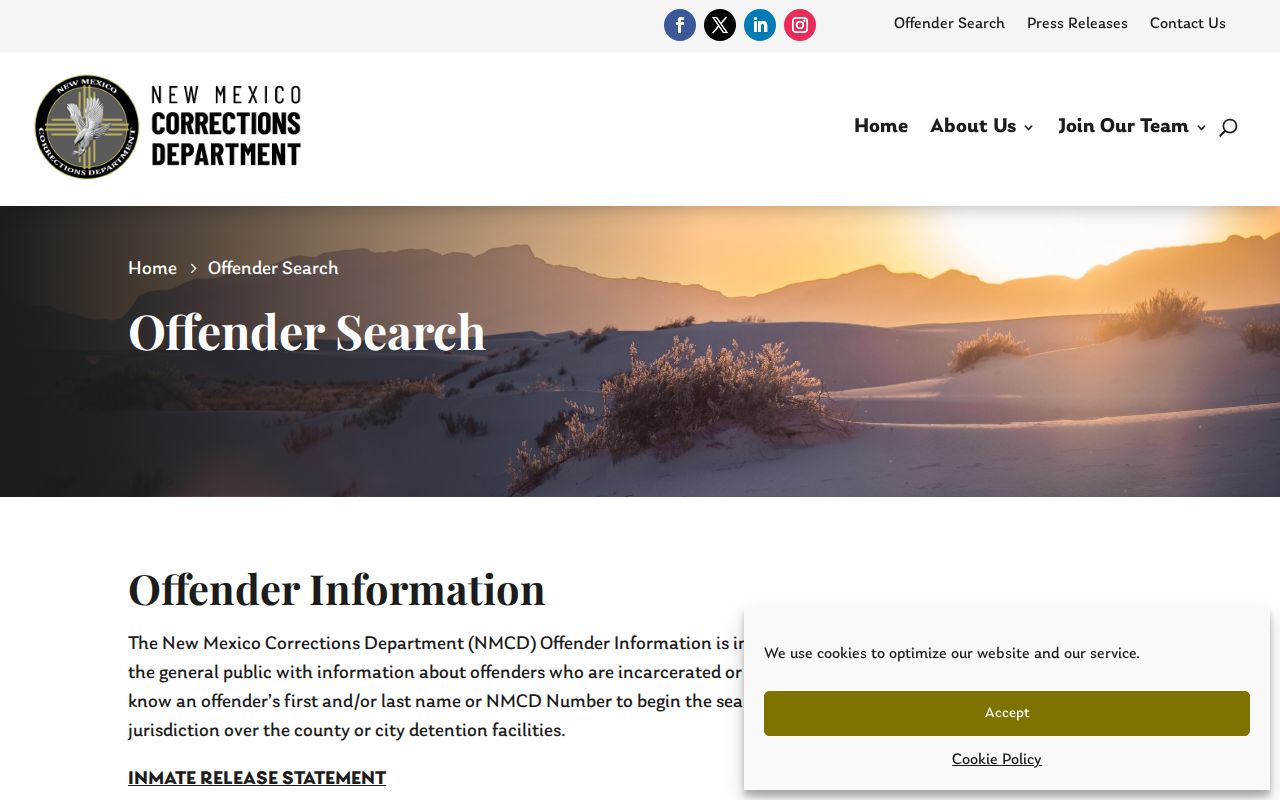
The official landing and search form appear without any absconder result or subject photograph. Use it when the question is New Mexico Corrections custody or supervision. For a judge-issued warrant, the court that signed it holds the record. Its clerk can explain status and procedure. Federal cases work differently. The USMS profiled-fugitive page is selective too, and it sits apart from the restricted Warrant Information System. The District of New Mexico's public docket can locate a federal case. But a public docket does not query NCIC, and sealed filings may not appear. Never treat a public profile as proof that a federal warrant is active or cleared. Only the court can confirm that.
If Your Name Is on a List
A possible match is a reason to verify the court record, not to assume the result tells the whole story. Compare the court, the case number, the event date, and whatever identity details the public record allows. Ask the issuing clerk directly. Is the warrant still active? What appearance or motion is required? Has the court recorded service, surrender, or cancellation? A lawyer can advise whether to seek a recall or a motion to quash, arrange a voluntary return to court, or address release terms. If a family member may be involved, use the case or citation information they provide and respect limits on confidential records. A recall asks the judge to withdraw the warrant. A motion to quash asks the judge to set it aside. The New Mexico warrant search channels can help locate the right court record, and the county directory routes to local court and sheriff contacts. Do not travel to a jail or send money on a roster entry alone. Confirm the court's process and any geographic or release condition first.
Before acting: Verify the warrant and its scope with the issuing court or a lawyer; a list entry alone does not confirm current status or surrender instructions.
Note: New Mexico surrender and release instructions come from the issuing court's current order and local process.
Why a New Mexico Warrant Is Missing
Statewide tools have blind spots, and knowing them saves wasted searches. Case Lookup may omit sealed or older records. Juvenile criminal matters have not appeared publicly since July 1, 2007. Municipal material is limited to historical criminal domestic-violence and DWI conviction information beginning September 1, 1991, not full city dockets. The Rule 1-079 court-access rule and the Children's Code govern protected and juvenile records. Paper-era cases may need a direct request to the court. Sheriff portals have a different gap. A portal may show only that agency's published search file, while the case and signed order stay with a court. The Bernalillo County Sheriff's Warrant Lookup offers search by name, warrant type, and warrant year. It does not cover other counties or guarantee a Metropolitan Court result. When Case Lookup or a local page returns nothing, check the spelling and number first. Identify whether the case belongs to District, Magistrate, Metropolitan, or Municipal Court. Then contact that court directly. For a ticket, start with the court named on it. The Motor Vehicle Division says it does not issue or confirm warrants. The New Mexico county directory and the official Judiciary Master List help find the local record holder. A blank result statewide or countywide is not proof that no warrant exists. Sealing orders and juvenile rules can limit what a clerk may release. The clerk can explain the authorized route but cannot override a restriction or disclose protected information.