
Bench Warrants in New Mexico
New Mexico treats a bench warrant as an order a judge signs inside a case already on the docket. Miss a hearing. Ignore a criminal summons. Either can move a judge to issue a Failure to Appear in Court (FTA) Warrant, though the court's form leaves room for other grounds too. A skipped subpoena counts. So can a release-condition violation, contempt, a probation problem, or an unpaid fine or cost. The reason on the signed order matters, because the fix and the next court event both flow from it. A bench warrant alone does not mean a new criminal charge was filed. In New Mexico, a missed appearance, a payment default after the case ended, and a probation matter run on separate tracks even when each one ends in the same kind of warrant. Some states lean on "capias" for an order hauling someone into court and "capias pro fine" for fine collection; the New Mexico Judiciary uses neither as its standard label. Read the wording on your notice, or ask the clerk to pin down the order type, court, case number, and where its status stands right now.
New Mexico Bench Warrant Status Trail
The Administrative Office of the Courts maps an Odyssey workflow for Failure to Appear in Court Warrants in District, Magistrate, and Metropolitan cases. The judge orders the warrant once a required appearance is missed, and court staff create the record and update it from there. Some locations push qualifying warrant and cancellation data electronically to DPS. Others still do it by hand. That rollout built no public statewide warrant list. Odyssey's internal warrant report and its filters stay court tools, so a public case index or a sheriff page cannot show the full trail.
| Judiciary status | What it records |
|---|---|
| Issued | A judge-authorized FTA order was created. |
| Served | Service or booking was recorded; confirm the resulting case event. |
| Canceled | The court withdrew the warrant for a reason other than service, surrender, or error. |
| Surrender | The person used a court-approved route to address the warrant; the case may continue. |
| Returned Unserved | An officer returned the order without execution. |
The Judiciary FTA warrant procedure spells out these labels. Updates reach public and law-enforcement views at different times, so confirm any New Mexico status with the issuing court.
How a Bench Warrant Is Issued
A New Mexico bench warrant starts with a judge's order in a case already before that court. For the standard FTA type, the trigger is a failure to appear for a required hearing or criminal summons. It is not a computer snapping at every missed deadline. Court staff log the order, its reason, release terms, geographic scope, and the steps the judge set. The record, plus any later return or cancellation, stays tied to the case. New Mexico's FTA procedure also draws lines. Missing a probation check-in, jail time, Pretrial Services, or a specialty court may call for a different warrant or case process instead. A payment or community-service default follows its own current rules too. So if a docket line says "warrant," ask first whether it is the FTA type, another bench warrant, or a separate arrest warrant before you assume what an appearance will resolve.
New Mexico FTA Warrants Need Notice
A missed date and a valid failure-to-appear finding are two different questions. New Mexico Magistrate Rule 6-205 and Metropolitan Rule 7-205 govern summons and nonappearance procedures, notice findings included. If court mail came back, or a summons may never have reached you, hold onto the envelope, your address history, and any returned-mail notice. Then ask the issuing clerk how the court accepts that material for the judge. The Magistrate Court rule and the Metropolitan Court rule do not cancel a warrant automatically over returned mail. The judge weighs the facts and decides whether the warrant, the hearing date, or another order should change. Confirm the active status and ask what proof or filing the court wants; an old docket entry answers neither question.
New Mexico Payment Warrants Follow Ability Review
New Mexico treats a missed payment differently. Effective October 9, 2025, Rules 6-207.1, 7-207.1, and 8-206.1 govern ability-to-pay review and alternatives in Magistrate, Metropolitan, and Municipal Courts. The rules require the court to assess ability to pay at sentencing. Full payment is not always possible. When it is not, the rules allow an individualized installment agreement, community service valued at a rate tied to twice the state minimum wage, or other appropriate relief. A court may modify an agreement up to three times for good cause. The Magistrate rule, Metropolitan rule, and Municipal rule spell out every step of that procedure. The usual sequence starts with a missed installment or service deadline. A summons generally follows within five days. It demands a response within fifteen days. The response can be payment, an appearance, or a request for a hearing. Stay silent and a warrant may issue. After a second failure-to-pay warrant, a different summons option applies and further extensions are limited. Arrest or surrender triggers a hearing. A person who remains in custody must receive it within three days. The judge can change the amount or the agreement. Contact the issuing court about that review instead of treating nonpayment as an initial failure to appear.
Bench vs Arrest Warrant
Both orders can put a person in custody. The legal starting points differ, though. In New Mexico, a bench warrant grows out of an existing case or court obligation, while a criminal arrest warrant rests on probable cause for an offense. That distinction guides which papers to request and which court procedure applies. The New Mexico arrest-warrant record follows a separate issuance and service process.
| Point | Bench warrant | Arrest warrant |
|---|---|---|
| Basis | Missed appearance or another court order in an existing case | Judicial probable-cause finding in a criminal matter |
| Common record | Case docket, reason, release terms, status and return | Charge, court command, scope, officer return and removal record |
| Who controls next step | Judge and clerk of the issuing court | Issuing court, with counsel and authorized officers as relevant |
| Does cancellation end the case? | No; the original hearing or obligation can remain | No; cancellation does not itself decide the charge |
New Mexico Bench Warrants at Safe Surrender
Safe Surrender schedules a court-date fix instead of an arrest. Judges and court staff take part. The March 27–28, 2026 event in Gallup accepted outstanding bench warrants from any New Mexico Magistrate Court, including cases filed elsewhere in the state. Favorable consideration was offered for a new date, a payment plan, or another compliance option. Dismissal was never promised. Nor were immunity, a fee waiver, or protection from arrest outside the event. That event has passed. No later date is posted now. The official New Mexico Courts Safe Surrender events page describes the program and future scheduling. That Court Operations page is a program description, not a live warrant roster or current event notice.
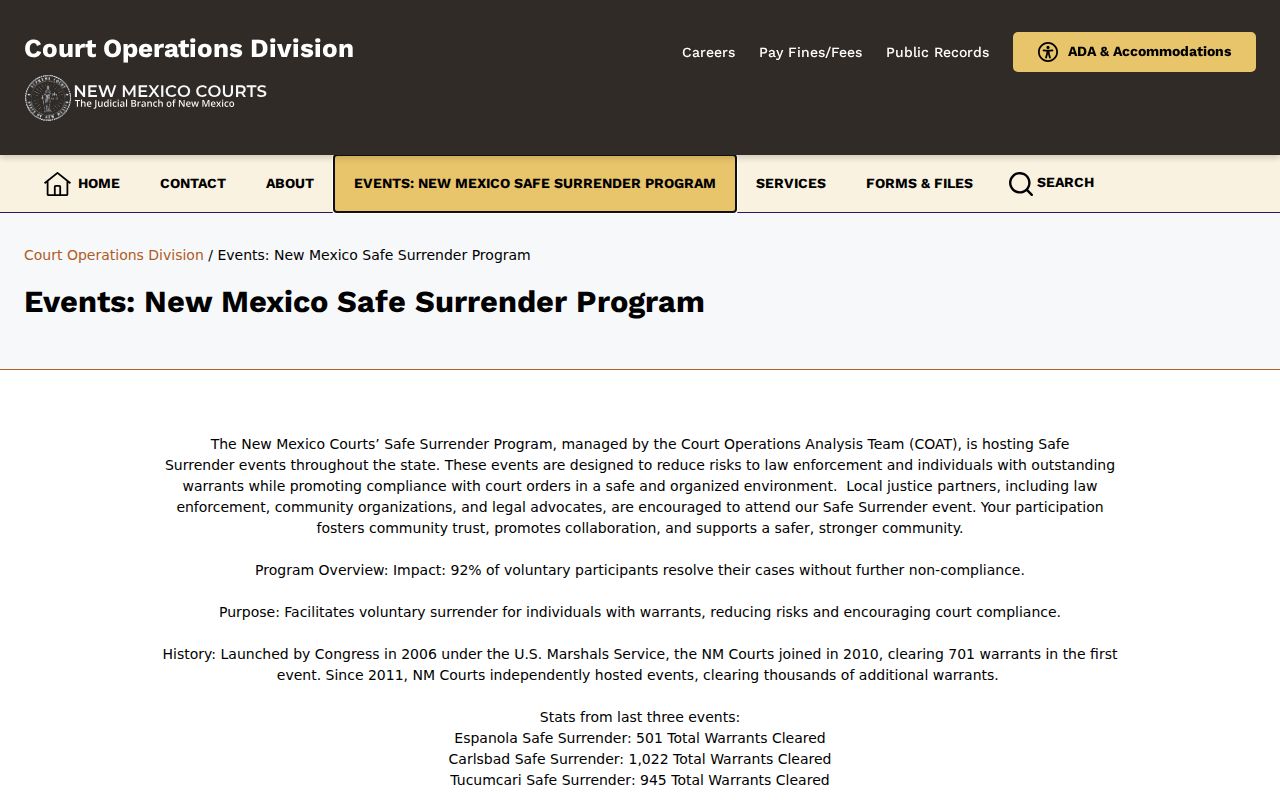
Event scope changes with each date, court, and location. The Gallup notice did not cover every District, Metro, Municipal, probation, or child-support warrant. Court Operations and the Courts HelpLine at 855-268-7804 answer scope questions. Confirm the specific order with its issuing court first. Never rely on a future New Mexico event without that confirmation.
How to Resolve a New Mexico Bench Warrant
Begin with the court that signed the order. No statewide agency can recall it. Recalling a warrant means asking the judge to withdraw it; quashing one means asking the judge to set it aside. A citation, summons, case number, public docket, or mailed notice can identify the right court. Then call the clerk. Ask for current status and instructions. New Mexico procedures turn on why the warrant issued, so a request to reset a hearing is not the same as a payment plan or probation review.
- Ask whether the order is active, what triggered it, and whether a judge requires an appearance.
- Ask what filing, proof, hearing request, or counsel review applies to this case.
- Confirm bond or release terms, where surrender is accepted, and whether advance coordination is needed.
- Follow the court’s direction, then ask for the signed order or docket entry and whether cancellation was sent to law enforcement.
- Keep separate obligations, such as a new hearing, fine, or probation condition, on the calendar.
Before you go: Confirm the court’s surrender location and release terms first; an active warrant may be served during an unplanned contact with law enforcement.
A phone or online payment is not a signed recall order. Bond works differently. The warrant and any later court order set its terms. Blank New Mexico forms set no statewide amount. Ask the court or jail whether bond is allowed, who accepts it, and which payment forms apply. It may only secure release. When the warrant involves an unresolved charge, probation, extradition, or possible custody, a New Mexico lawyer or legal aid provider can explain what a motion or a surrender would mean.
New Mexico Bench Warrants and Online Payment
New Mexico's Judiciary payment portal handles money, not paperwork. A paid balance does not cancel a bench warrant. It does not complete a hearing requirement either. In fact, the portal itself tells users to contact the court about nonfinancial compliance. A payment receipt, a docket entry, and a judge's warrant order are three different records. Ask the clerk what remains after any payment toward a New Mexico case. The official New Mexico Judiciary payment portal posts that warning with its payment service. Confirm any warrant, appearance, or service obligation through the issuing court.
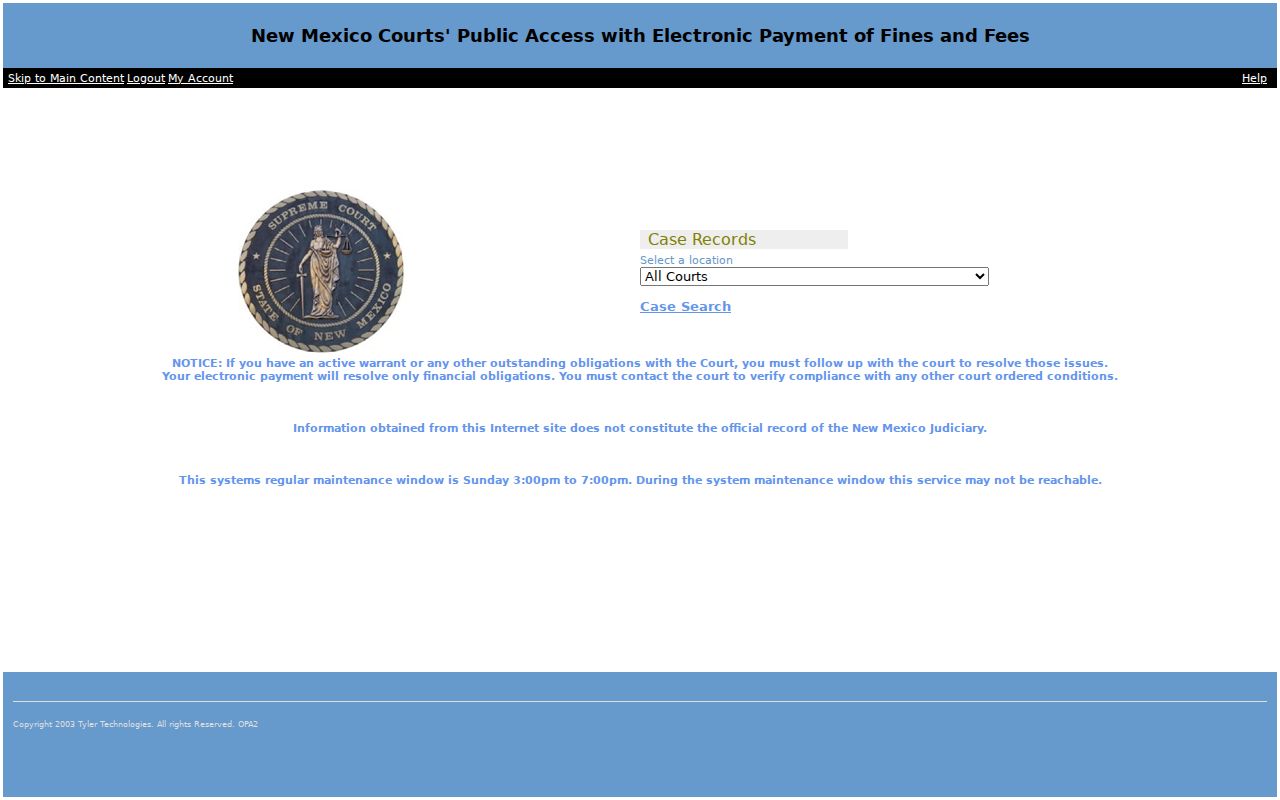
The portal notice makes a fair point. A receipt covers a financial transaction, not necessarily every New Mexico warrant or hearing requirement. Do not trust old references to a general USD 100 Magistrate or Metro warrant fee for a new assessment. That fee authority ended effective July 1, 2024. Current Form 9-212C states that Municipal Courts are not authorized to assess the old amount. A legacy balance may still need court review. Ask the clerk rather than assuming an old charge is current or erased.
Which Court Issued It
The case type tells you more than the county name does. In New Mexico, District Court covers felonies, family matters, and juvenile cases. Magistrate Courts take many misdemeanors, DWI and traffic cases, and preliminary-felony work. Bernalillo County Metropolitan Court runs its own countywide caseload of misdemeanors, traffic, DWI, and first appearances. Municipal Courts handle city ordinance, petty-misdemeanor, and local traffic matters. There is no general criminal county court tier here. A sheriff can serve an order without holding the court file, and the county clerk is not usually the criminal case clerk. Start with the New Mexico county directory to reach the local layer. Then confirm the named court and clerk through the New Mexico Courts Master List. Albuquerque cases may sit in Metro rather than the municipal court you might assume. The case number and court caption settle that question for New Mexico litigants every time.
New Mexico Bench Warrant Form Fields
Blank New Mexico forms explain why a docket summary can leave status questions open. Form 9-212C serves Magistrate and Municipal Courts. Form 9-212A serves Metropolitan Court. Either document can name the case, the charging agency, the reason, the release option, the geographic scope, the information-system destination, the judge, the date, and the officer return. Those are form fields, though. They are not a public list of subjects, and no portal promises to display them all.
- Issued
- The judge authorized the warrant and it was entered into the court process.
- Served
- Service or booking was recorded; ask the court what hearing or case action follows.
- Surrender
- A court-approved return or contact addressed the warrant, but the underlying matter may continue.
- Returned unserved
- An officer sent the warrant back without executing it; confirm whether the court still treats it as active.
Blank forms carry sensitive identifier fields for official use. New Mexico public pages should never copy a filled warrant or a subject's personal details. Request an authorized copy from the issuing court, and ask the clerk to explain any status term in the case record.